
Riverside City Directory Collections
Riverside has several historical directory paths rather than one perfect run. The earliest verified local volume is the History and Directory of Riverside County, 1893-4, while Riverside Public Library evidence covers a locally consulted run from 1902 through 1936. A nearby Heritage Room preserves Riverside City and County directories on microfiche from 1889 through 1966. National Archives research notes a smaller Riverside run on microfilm. Each source answers a different question, so the year and keeper matter as much as the person’s name. That collection evidence is strongest when its edition and repository are recorded together.
| Collection | Years | Where Held | Access |
|---|---|---|---|
| History and Directory of Riverside County, A.A. Bynon & Son | 1893-94 | Library of Congress | Free public-domain scan, OCR, and download |
| Riverside city directories | 1902-1936 confirmed as locally consulted | Riverside Public Library Local History Archives | Ask the Archives; complete shelf run and publishers need confirmation |
| Riverside City & County directories | 1889-1966 | Corona Public Library Heritage Room | Microfiche in the Heritage Room |
| Riverside city directories | 1927, 1929-1934 | National Archives research listing | Microfilm reference; ask a library or archives for access |
| Sanborn fire-insurance maps | 1895, 1908, and 1908 republished 1952 | RPL microfilm and local historical repositories | Companion address and building evidence |
The table shows confirmed touchpoints, not a promise that every year survives. Riverside Public Library has not published a complete directory publisher chronology in the research record, and no final printed year was verified. The Corona set is a county-area fallback, not proof that every fiche frame indexes Riverside city. When a named year is absent online, use the library, Heritage Room, National Archives listing, or a focused records request instead of filling the gap with a guessed date.
Open the 1893-94 Riverside City Directory
The 1893-94 Bynon volume is unusually useful because it sits near Riverside County’s creation and before the 1890 federal population schedules can help. The Library of Congress item for the Riverside history and directory provides a public-domain scan with 360 images, OCR, and download options. Its imprint identifies A.A. Bynon & Son and the Riverside Daily Press printing office. The volume is not a current roster. It is a dated view of the people and businesses a publisher chose to list.
The OCR makes a quick first pass possible, but the page image should settle a doubtful letter. One inspected entry names “DICKSON G W,” gives the title “city marshal and tax collector,” places the office at City Hall, and gives a residence at the corner of Eighth Street and Park Avenue. Nearby entries separate a Riverside News Company connection from a packing-house foreman. Occupation, office, and residence can therefore divide two people with similar names.
That detail also reflects Riverside’s citrus-era economy. A directory search can surface growers, packers, irrigators, and other local roles, then point toward a newspaper notice, a property record, or a family history source. A listed address remains a claim tied to the publication cycle. It does not establish ownership, a complete household, or continuous residence.
Riverside Records Behind City Directories
Riverside Public Library’s Local History Archives is the main local access channel for printed directories, maps, photographs, subject files, newspapers, and other regional material. The Main Library is at 3900 Mission Inn Avenue, Riverside, with a main-library phone of 951-826-5201. The Local History Archives has separate hours, generally Tuesday through Thursday from 2 to 6 and Friday through Saturday from 2 to 5, with Sunday visits by appointment. Archives help is available at 951-826-5301 and localhistory@riversideca.gov.
Use the Riverside Local History Archives access page to check current hours, contact points, and digital collections before a visit. The BiblioBoard local-history module has collection-dependent material, but no digitized Riverside city-directory run was verified there. For an obituary or Press-Enterprise question, the library accepts requests by phone or email. A researcher outside the area can ask a library to borrow Press-Enterprise microfilm from the California State Library through interlibrary loan.
The access chain matters when a directory gives only a name and street. Library staff can identify a volume, explain a shelf gap, or point to a newspaper date. They cannot turn an incomplete listing into proof of residence. A good request names the person, approximate year, street or occupation, and the kind of local-history item sought. See the Riverside archive source record before traveling.
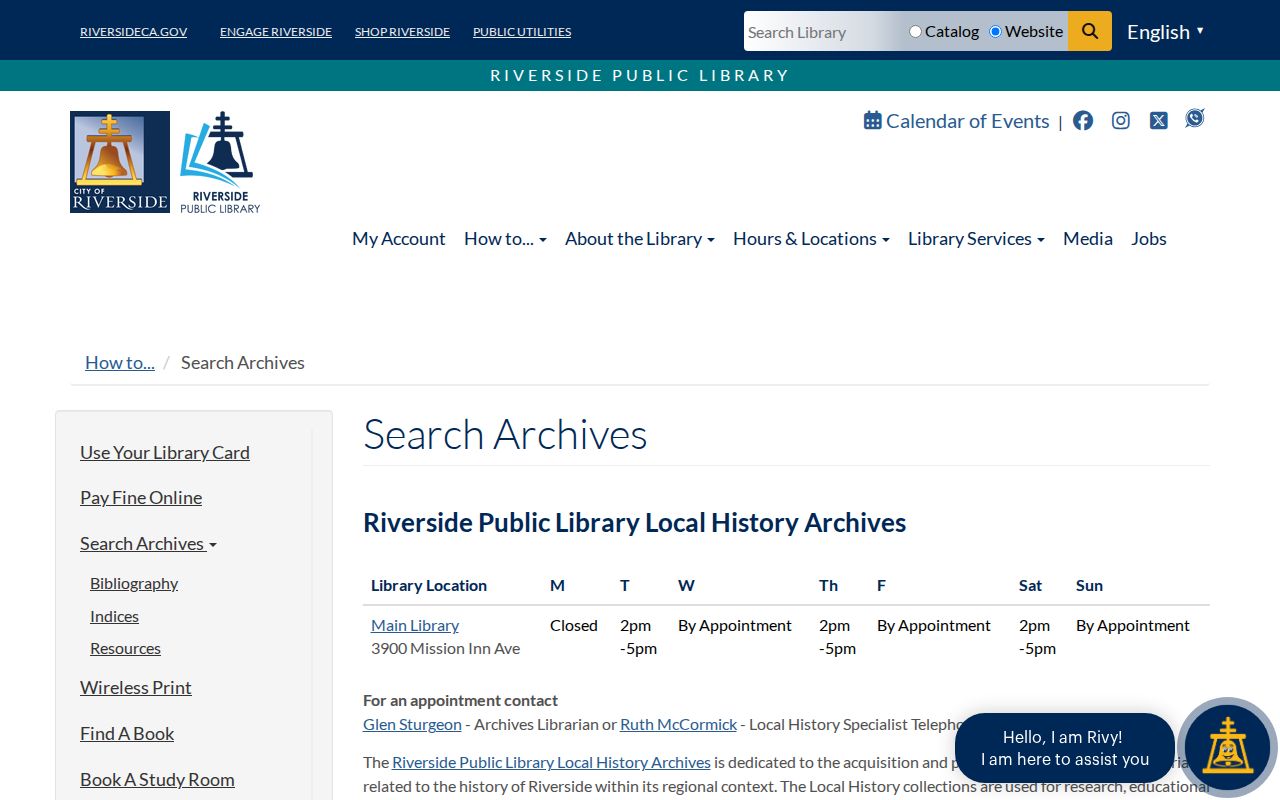
The archive access image marks the practical starting point for a local-directory request: confirm hours, ask about the years held, and use staff help when a printed volume or obituary is not indexed online.
Corona’s Riverside City Directory Microfiche
Corona Public Library’s Heritage Room is the clearest documented nearby fallback for a long Riverside volume run. Its local-genealogy page identifies Riverside City & County directories on microfiche from 1889 through 1966. That span reaches back before the Bynon volume and forward across much of the twentieth century. It can bridge a missing Riverside Public Library year, but the frame still needs to be read for its place label and edition.
The Heritage Room also lists hardcover Corona directories, a California Death Index for 1905-1939, a Marriage Index for 1960-1985, and obituary clippings from the Corona Daily Independent and the Press-Enterprise. Those are useful neighboring sources for a family trail. They are not a claim that every Corona item indexes Riverside residents, and they should not replace a Riverside custodian when the question concerns a local certified record.
The Corona Heritage Room directory source is the best place to confirm access before relying on the microfiche run.
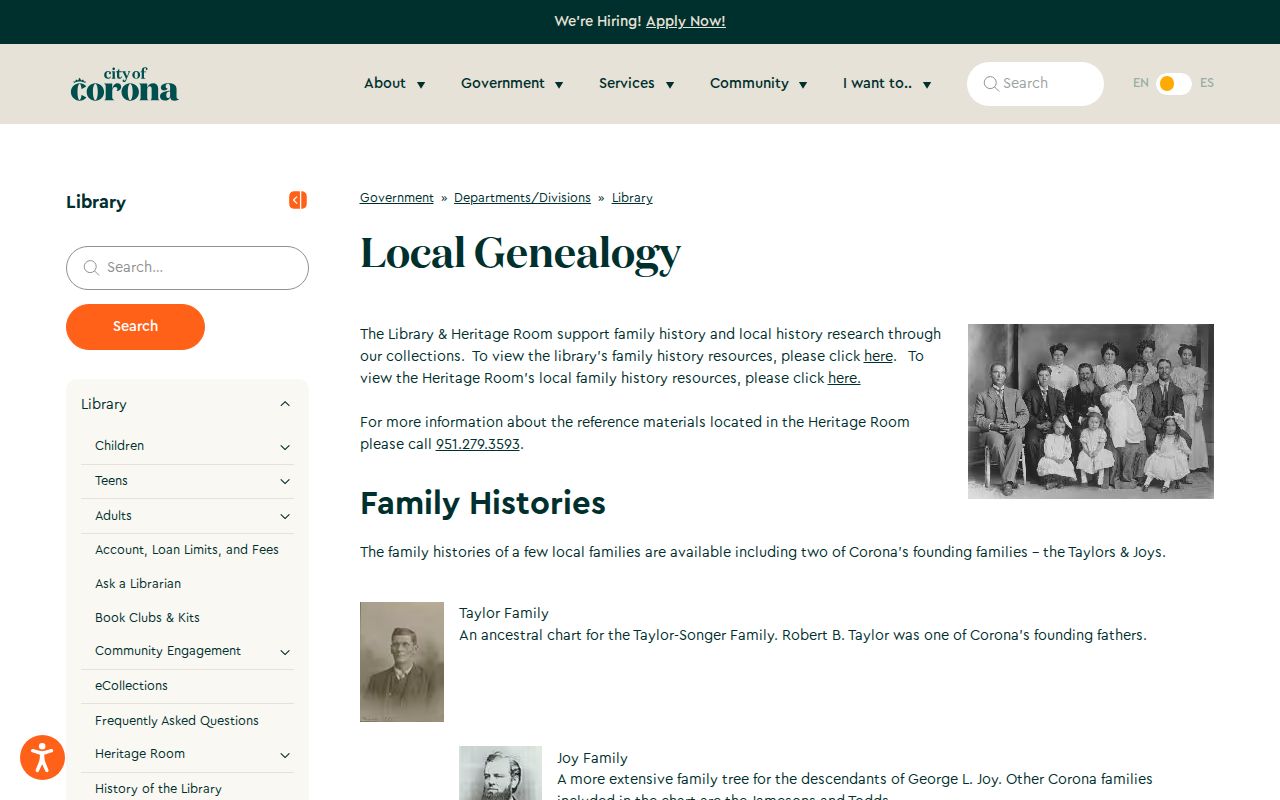
The Corona image represents a geographic fallback, not a second Riverside index. Record the edition title, city label, and frame details so a later researcher can repeat the search.
National Archives Riverside City Directory Years
The National Archives research material notes Riverside volumes for 1927 and 1929-1934. Those dates are valuable between the early local shelf and later county-area fiche, but they are a reference to microfilm availability, not a guarantee of a continuous series. The National Archives city-directory research page helps place the listing beside census research. A library or archives staff member can help determine whether a reel or copy service is available for the year needed.
Use a National Archives directory as a dated checkpoint. Capture the exact name, occupation, address, and any street-order entry. Then compare the same person with the 1930 census or with a Riverside newspaper. Differences may show a move, an indexing choice, a misspelled surname, or a person who was not listed that year. They do not, by themselves, show that a household left Riverside.
The National Archives census research source supplies the broader release context. Printed volumes and census schedules are related but distinct records, and a directory often fills the years between census snapshots.
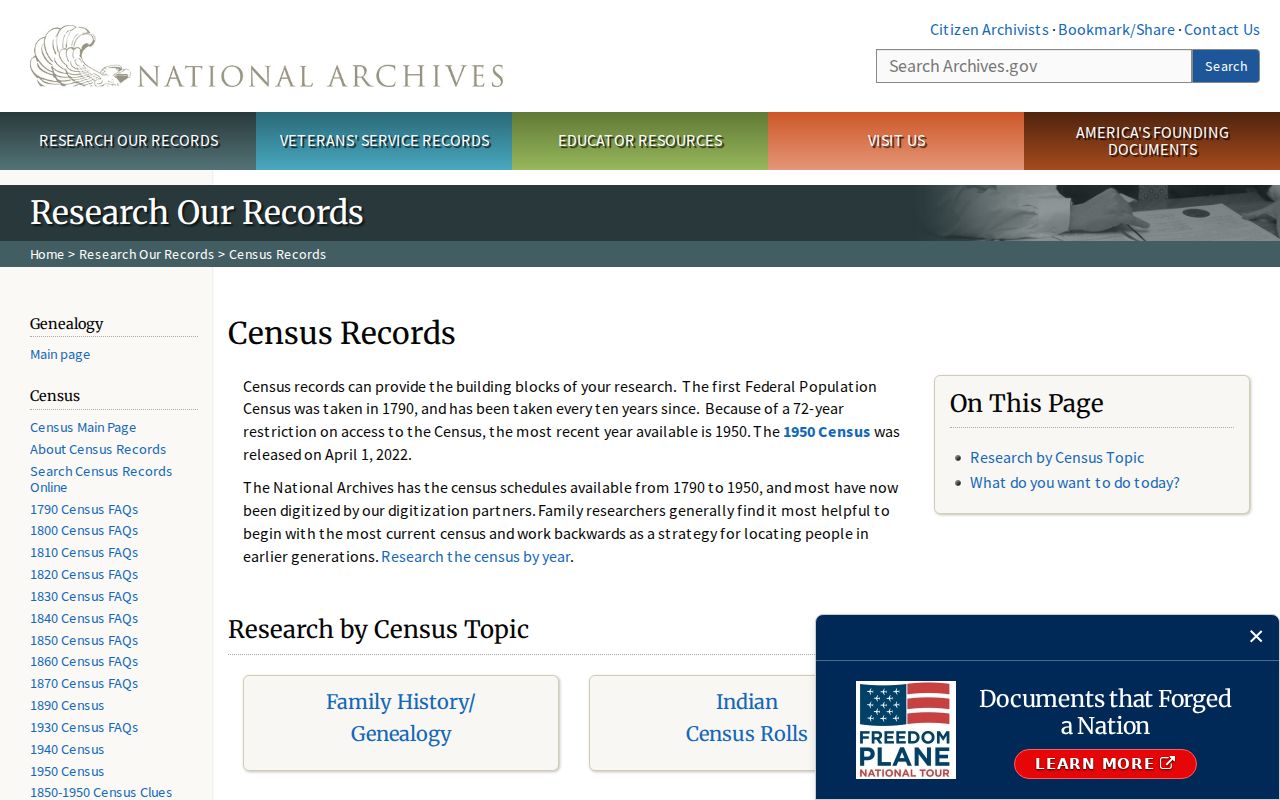
The National Archives image points to a research shelf, not an online resident search box. Start with the listed year, then ask for the correct microfilm or reproduction channel.
Read a Riverside City Directory Entry
A Riverside entry is a compact set of clues. The inspected Bynon examples show a surname and initials, an occupation or civic title, a business connection, an office, and a residence written as a street or intersection. The small marks matter. In the local sample, res identifies a residence, cor signals a corner, and ave shortens avenue. Read the volume’s own key before expanding an abbreviation from memory.
| Name | Surname and initials, with spelling kept exactly as printed or scanned. |
|---|---|
| Occupation or title | The civic role or work description attached to the person in that edition. |
| Business connection | Company or office clue when the entry supplies one. |
| Residence | House number, street, or intersection, often marked with the local abbreviation res. |
| Spouse or owner mark | No spouse-in-parentheses or owner/renter mark was confirmed in the inspected sample, so neither should be assumed. |
- Criss-cross directory
- A street-order or address-order section that can connect a known house to a listed person. No digitized Riverside criss-cross run was verified.
- Householder index
- An index arranged around the principal listed resident or household name, useful when a full name search is hard to read.
- Abbreviation key
- The volume’s own explanation of short forms such as
res,cor, andave; photograph or transcribe it before working through pages.
Capitalization may mark a paid or prominent entry, but that interpretation was not verified in the inspected volume. Treat every local convention as a question for the specific edition. A directory listing is strongest when name, address, occupation, and date agree with another source.
Riverside Sanborn Maps Close Directory Gaps
An address can disappear because a street name changed, a number shifted, an edition skipped the household, or the scan is hard to read. Riverside’s property-research chain joins city directories with Sanborn fire-insurance maps, photographs, subject files, newspaper articles, books, historical maps, permits, and tract records. The verified local Sanborn references include February 1895, 1908, and a 1908 map republished in 1952. They can show a building footprint, use, materials, and the older street context without pretending to name every occupant.
The city property-research material points researchers to the Public Works tract-map collection and street-name-change index, the Museum of Riverside’s original Sanborn maps, directories, photographs, subject files, and plans, and the Assessor’s ownership and construction evidence. The Riverside property research packet records that repository chain. Use the legal description, parcel number, lot, or block when the printed street name no longer matches.
Riverside’s street history has a clear county boundary as well. The city was incorporated in 1883, while Riverside County formed in 1893 from parts of San Bernardino and San Diego Counties. A pre-1893 property or court clue may therefore sit with a predecessor county keeper. The address is only the visible label; the legal description and county date carry the trail across that change. See the Riverside archive research resources source for the local map and directory path.
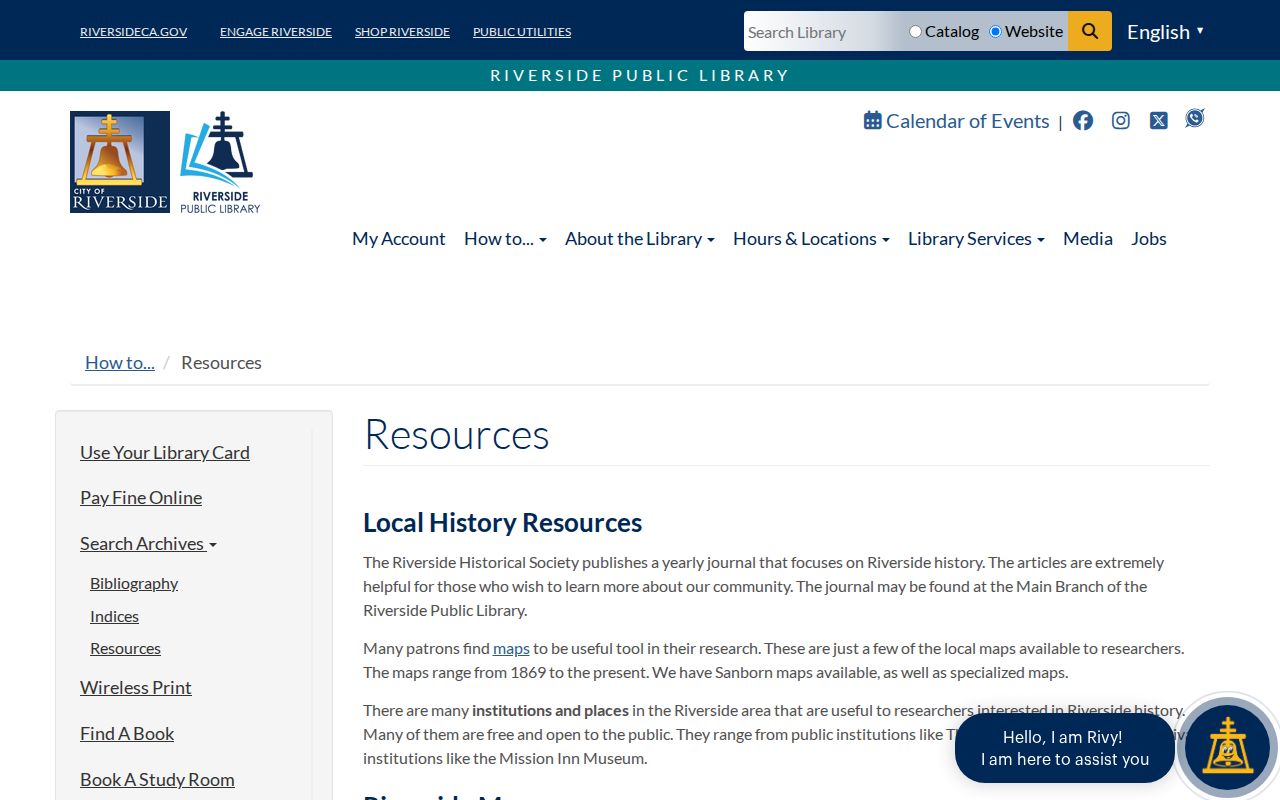
The resources image ties a Riverside directory search to the map, newspaper, and local-history tools that can explain a missing or changed address.
Riverside Directory Bibliography and Clues
The official Riverside local-history bibliography is a useful finding aid before a deep shelf search. It identifies the 1893-94 history and directory and places that volume in a larger record landscape. A bibliography does not expose every page, but it can supply a title, date, and repository lead that makes a library request precise. That is especially helpful when a surname has several spellings or when the same street appears under older wording.
The Riverside local-history bibliography source should be paired with the archive contact rather than treated as a full name index. Search the title first, then confirm whether the requested year is in the Local History Archives, on microfilm, in a nearby collection, or only in a catalog record.
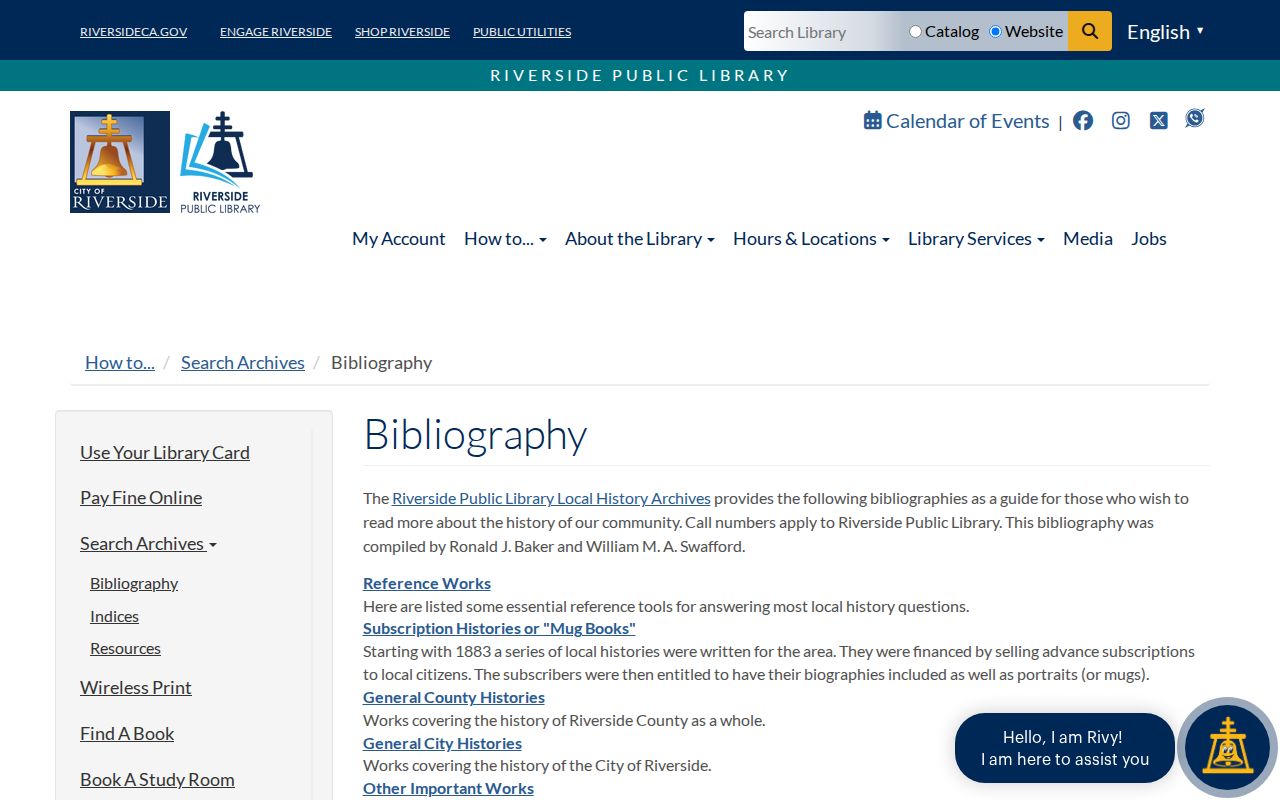
The bibliography image shows why a title-level clue matters. It can turn a vague request for an old directory into a dated, checkable source request.
For a broader resident-history trail, UCR Special Collections holds manuscript collections such as Riverside City and County, Press-Enterprise, Avery Field, and family papers. Riverside Historical Society journals add biographies and neighborhood histories. Neither collection is a current resident list, but both can supply a name, photograph, or community clue for the next volume search.
Trace a Riverside Household Through City Directories
A household trail works best when each directory entry is treated as a dated observation. Begin with the person’s name, then let the address, occupation, and nearby records test the match. The 1890 census loss makes the 1893-94 volume especially important for the earliest bridge. For later work, pair directories with the 1910, 1920, 1930, 1940, and 1950 federal schedules, with 1950 the newest released population schedule under the 72-year rule as of 2026.
- Search the alphabetical section for the full name, initials, former surname, married surname, and likely spelling variants. Save the exact printed form.
- Record the residence, occupation, business connection, and any intersection. These clues can separate two people who share a surname and first initial.
- Compare the next available edition. A move, death, new occupation, OCR error, or skipped year can all explain a change.
- Use a street or criss-cross section when the edition has one, then check the address against Sanborn sheets, permits, deeds, or tract maps.
- Pair each directory checkpoint with the closest released census. Finish a family-history trail with an obituary, cemetery clue, or probate file, while keeping each source’s limits clear.
When a person vanishes from a Riverside volume, do not label the result “moved” without a second clue. A person may have died, boarded elsewhere, been omitted, or appeared under an index variation. The Riverside Public Library obituary request service, Press-Enterprise microfilm, and local history collections can help test those possibilities. For a modern confirmation after a historical find, the Riverside resident lookup workflow adds current record custodians without rebuilding the historical shelf.
Riverside City Directory History and Census Gaps
Riverside’s record history explains why no single volume answers every question. The city’s founding, county formation, printed volumes, library changes, and new preservation work each add a different layer. The dates below are documented touchpoints, not a claim that publication was continuous between them.
| Date | Research milestone |
|---|---|
| 1870 | John North and eastern colonists founded Riverside, creating the early civic setting behind later address records. |
| 1883 | Riverside incorporated, before the county was formed. |
| 1889-1966 | Corona Heritage Room records a Riverside City & County directory microfiche span. |
| 1893-94 | Bynon’s county history and directory creates a digitized pre-1900 checkpoint. |
| 1893 | Riverside County formed from portions of San Bernardino and San Diego Counties; earlier records may follow predecessor custody. |
| 1902-1936 | Riverside Public Library evidence confirms a locally consulted city-directory run, with complete coverage and publishers still needing confirmation. |
| 1927, 1929-1934 | National Archives research notes additional Riverside city-directory microfilm years. |
| 2025-2026 | Women of Riverside historic-context work gathers names, places, and stories through directories, Sanborn maps, census, newspapers, and archives. |
The most useful habit is to write down the keeper and date beside every name. That small record of provenance protects a family-history conclusion from turning into a guess when one Riverside edition uses a different spelling or when a street changes its name.