
Sources Behind Riverside Previous Residents
A Riverside address history needs an era map before it needs a name search. The current parcel record anchors the place, the recorder supplies title events, directories supply publication-year address clues, census schedules add household context, and permits or Sanborn maps show how the property changed. The table separates those roles so a dated listing is not mistaken for ownership or continuous residence.
| Source | Years It Covers | Where Held | What It Shows |
|---|---|---|---|
| ACR assessor and GIS | Current parcel record | County Property Search and Map My County | APN, PIN, situs, map and assessment clues |
| Recorder index and books | 1975 forward online or office; 1893-1974 earlier books | ACR, Gateway and County Archives | Recorded parties, transfers, liens and legal descriptions |
| History and Directory of Riverside County | 1893-94 | Library of Congress scan | Name, occupation, business or office location, and residence |
| Riverside city directories | 1902-1936 confirmed locally | Riverside Public Library Archives | Dated address and occupation clues |
| Riverside city and county fiche | 1889-1966 | Corona Heritage Room | Address entries across many editions |
| Federal census | 1900-1950 released schedules | NARA and authorized research access | Household relationship, age, birthplace and address context |
| Sanborn maps | 1895, 1908, and 1952 reprint | RPL and Museum of Riverside | Footprint, use, materials and street setting |
| City building permits | Life of the structure | City POSSE and Building & Safety | Work, applicant, contractor and inspection clues |
Start with the source closest to the question. A title question starts with the APN and recorder. A household question starts with a directory or census year. A changed structure calls for Sanborn sheets and permits. If an address falls before the county was formed, the record may belong to a predecessor county rather than Riverside County.
Riverside Homes Start With an APN
Begin with today's address in the Riverside County Property Search. The advertised routes are Assessor's Parcel Number, Property Identification Number, and Property Address. Copy the APN or PIN, the situs wording, any legal-description clue, and the owner mailing address shown by the official record. Then open Map My County to compare the parcel shape, address point, nearby lots, street centerline, and jurisdiction.
The APN joins systems more reliably than a typed street label. The situs identifies the physical parcel, while the mailing address is where notices go. A trust, second home, post office box, or owner living elsewhere can make those addresses differ. The parcel card does not prove who occupied the property, but it gives a stable key for the next deed search.
Owner-name searching is not advertised as a public web route on the assessor screen. If the address search is thin, Riverside County points researchers to office computers and microfiche, with the Gateway office at 2724 Gateway Drive and the downtown office at 4080 Lemon Street. The ACR locations page lists the offices, hours, and 951-486-7000 as the main phone.
Tracing Riverside Previous Residents Through Deeds
A deed chain follows recorded title events, not every household. Once the assessor supplies a current owner clue and legal description, search the Riverside Official Records Search by party, recording date, document type, or document number. The address itself is not the recorder's main key. Move from the current acquisition instrument to the prior seller, then use the seller as an earlier grantee while checking dates and legal description.
- Save the current APN, legal description, owner clue, and any sale or assessment date.
- Search the current owner as a party, narrow the recording dates, and review deed-like document types.
- Record the document number, date, indexed parties, book or page clue, and the seller named in the instrument.
- Search that seller as an earlier grantee, rejecting same-name hits that do not fit the parcel or date.
- Repeat backward, then take the last reliable party and legal-description clues to Gateway or the County Archives for earlier material.
- Grantor and grantee
- The grantor transfers or grants an interest; the grantee receives it in the recorded instrument.
- Chain of title
- The linked sequence of recorded transfers used to trace an interest in one parcel backward.
- Legal description
- The formal lot, block, tract, or other land description that can stay useful when a street name changes.
- Criss-cross directory
- A historical address-ordered directory that can connect a street location to a listed name.
Index entries are finding aids. Copies and images can require payment, and restricted documents may not display every field. A deed proves a recorded transfer between named parties. It does not prove that a listed owner lived at the parcel or that a later household member held title.
Riverside Mail Searches Need a Narrow Date
Riverside County's recorder access rules make an old address trail much easier when the estimated year is specific. For a pre-1976 document, a mail search is limited to a two-year window after the estimated recording year. A request that only says “sometime before the old house was remodeled” can miss the instrument or create avoidable back-and-forth. Use a directory, obituary, permit, tax clue, or family paper to narrow the likely transfer first.
The official ACR copy form asks for the document title or type, complete party names, an estimated recording date, and an optional parcel number when the document number is unknown. Mail requests go to Attn. Certified Section, P.O. Box 751, Riverside, CA 92502-0751. Checks or money orders are payable to Riverside County Recorder, and the county says not to send cash, temporary checks, or third-party checks.
Research tip. A two-year pre-1976 mail window rewards a dated clue. Narrow the year with a directory or permit before asking the recorder to search an older volume.
Online orders average about 48 hours before mailing, while mail fulfillment is commonly one to two weeks and the counter can handle routine same-day work unless the research is extensive. The index itself is free to search. Copy fees, certification, postage, and the current card fee should be confirmed with the recorder before ordering.
Riverside Recorder Computers Reach 1975
Recorder office computers reach 1975, while 1974 and earlier research is centralized at the Gateway location. That number marks a change in access, not the beginning of Riverside title history. The county's land records begin with county formation in 1893, and older material may also require predecessor-county custody. Save every newer index clue before making the historical trip.
The Robert J. Fitch County Archives preserves Board actions from 1893 along with assessment rolls, assessor map books, deeds, official records, homesteads, leases, chattel mortgages, water and mining records, irrigation-district sale certificates, and grantee, mortgagee, map, notice, and judgment indexes. It is a research repository, not merely an overflow counter. Appointments are Tuesday through Thursday, 9 a.m. to noon, through 951-486-7327 or CountyofRiversideArchives@asrclkrec.com.
The Riverside County Archives research listing is the best starting point for planning that visit.
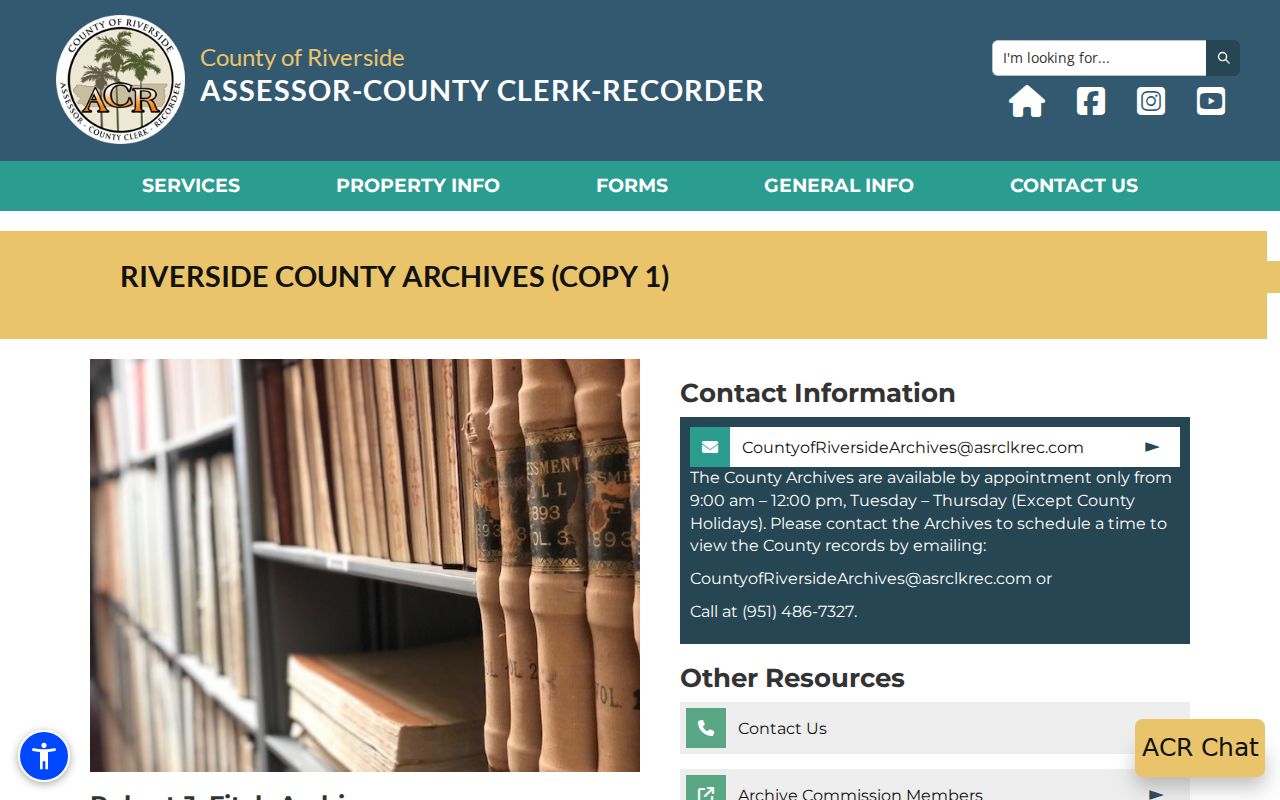
The archive source shows why an address history may need original county series after the modern recorder screen stops.
The 1893 Riverside County Boundary
Riverside County formed on May 9, 1893 from portions of San Bernardino and San Diego Counties, with Riverside as the county seat. A Riverside property trail that predates that boundary may therefore be filed under a predecessor county, depending on where the land sat and when the event was recorded. The county's history is documented by Riverside County, while the city dates its own founding to 1870, incorporation to 1883, and charter to 1907.
This boundary is a practical search rule. A missing early Riverside deed is not proof that the transfer never happened. Test San Bernardino or San Diego custody when the date and location support it, and keep the legal description, tract, map, and party names together. The County Archives, Public Works map files, and local-history repositories can help connect the old jurisdiction to the later county record.
The first verified local directory is the 1893-94 Bynon volume, so the county line and the directory date reinforce one another. The volume can supply a residence or occupation clue while the recorder or archive supplies the land record. Neither source alone establishes a continuous household.
Riverside Sanborn Maps and Permit Clues
When an address changes or a building seems to vanish from a directory, Riverside's property-research chain turns to maps and permits. The city's “How to Research a Property” packet identifies Riverside Public Library Sanborn microfilm, photographs, postcards, directories, subject files, newspaper articles, books, and historical maps. It also points to Public Works original tract maps and the street-name-change index, Museum of Riverside originals, and Assessor ownership and construction-date evidence.
Riverside Sanborn evidence is verified for February 1895, 1908, and a 1908 map republished in 1952. A Sanborn sheet can show a footprint, use, materials, and street context. It does not name every occupant. The Museum of Riverside holds original Sanborn maps, directories, photographs, subject files, and architectural drawings or plans by appointment. RPL holds the local microfilm and can help bridge a nonlocal request.
City permits add a different layer. Completed permits remain for the life of the structure, and the Riverside POSSE portal searches by address, permit number, contractor, date, project name, or planning fields. Details can show work description, contact information, and activities. Those facts date a project or identify an applicant, not necessarily a person who lived in the property.
Use maps, permits, deeds, and directories together. A lot or block reference can survive a street label change and give the next search a better key than a modern address alone. That stable parcel reference is the anchor for a previous residents search when the street number has changed.
Past Riverside Households in Directories and Census
Owners are only one part of the previous residents trail. The 1893-94 History and Directory of Riverside County is a free 360-image Library of Congress scan with OCR and download options. Its entries can show a surname and initials, occupation or title, business or office location, and residence. A sample places a city marshal and tax collector at an intersection residence, while nearby entries separate a business connection from a home address. The entry proves a dated publication listing, not title ownership or continuous residence. These are the dated sources for previous residents, and each one has a different evidentiary role.
Riverside Public Library confirms locally consulted city directories from 1902 through 1936. The Corona Heritage Room lists Riverside city and county microfiche from 1889 through 1966. The Riverside directory collections page is the place to compare those runs and learn how a street section works. Pair the directory with the nearest released federal census instead of treating one edition as a full household roll. The most useful past residents clues are dated, address-specific, and checked against a second source.
- Capture the exact directory year, name spelling, street form, intersection, occupation, and any abbreviation such as res, cor, or ave.
- Match the address to the nearest available census year. Federal population schedules from 1900 through 1950 are the useful released span in 2026.
- Compare household names, ages, birthplace, and address context, allowing for a move between the publication date and enumeration date.
- Test a changed street against the APN, legal description, Sanborn sheet, tract map, and permit history.
- Use a newspaper, obituary, probate file, or later deed as a separate endpoint rather than filling a gap by assumption.
RPL's Main Library is at 3900 Mission Inn Avenue, with Local History Archives access Tuesday through Thursday from 2 to 6, Friday and Saturday from 2 to 5, and Sunday by appointment. Archives help is available at 951-826-5301 and localhistory@riversideca.gov. Nonlocal researchers can ask a library about Riverside Press-Enterprise microfilm through interlibrary loan.
For a digital local-history starting point, use the Riverside Public Library BiblioBoard collection.

The digital collection can add photographs, subjects, and local context to a dated address trail, but it is not a current name index.
Lawful use. Previous-resident research is suited to house history, family history, and personal curiosity. Do not use a historical or current record to stalk, threaten, or harass a living person.
Closing a Riverside Trail With Probate
Obituaries, cemetery evidence, probate, and a final deed can close one chapter of an address history, but each source has a different weight. Riverside Public Library accepts local obituary requests by phone or email and can point researchers to Press-Enterprise microfilm. Riverside Superior Court probate cases are generally online from July 1994 forward, while older files require clerk research. A probate petition can name a decedent, petitioner, heirs, or interested parties when the public filing includes them.
Use the Riverside National Cemetery's federal grave locator or on-site kiosk for cemetery questions, and treat an obituary as family context rather than proof of title. A final deed can show a transfer. A probate file can explain an estate process. A directory can place a person at an address in one edition. Agreement across these sources is stronger than a single same-name match.
When the present-day parcel needs a fresh, street-level record chain, the Riverside street directory workflow returns to APN, GIS, permits, and the recorder index. A previous residents search is complete only when its dates, source roles, and unresolved gaps are written down clearly. This is how the previous residents trail moves backward without treating a same-name seller as proof.